
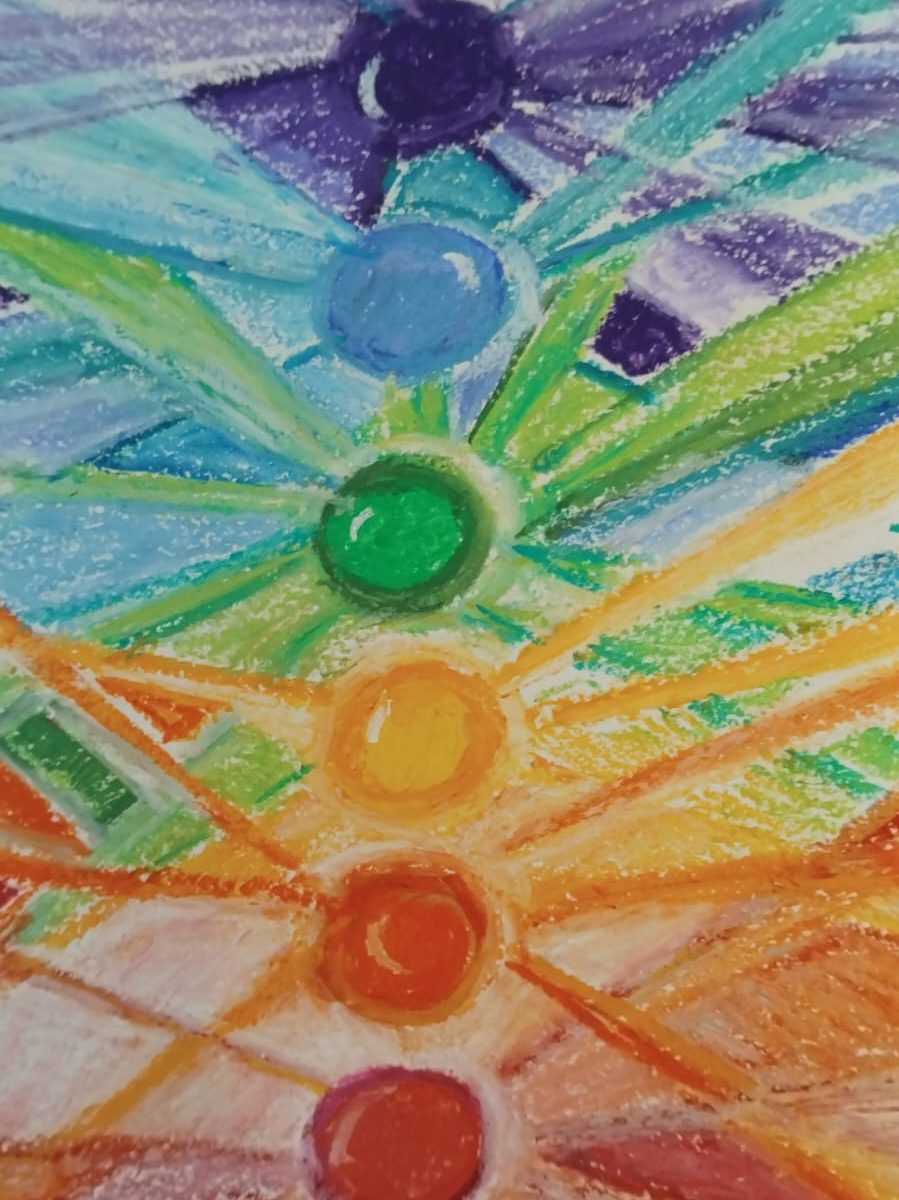
Moving Forward Without Losing Yourself

Art by Julia Chi

Following on from last week, I was reflecting on my work with people, which is often about their goals in life and the challenges they encounter in all areas of their lives…

And the question arises ‘How do we move forward in life, embrace all the challenges and stretch for goals without losing ourselves…?

How do we stay connected to presence – to our true self – whilst living fully in the world?

There is always an inner journey unfolding.

Even as we: pursue big goals, work within organisations, create families navigate full and complex lives, there is something within us that is always aware.

A quiet witnessing presence.

And if we can stay connected to that, even if it feels it’s only a small thread at times,  then we remain rooted in something deeper than the activity of our lives.

Of course, we can step away from the world.

We can retreat from the world, and live somewhere away from the hustle and bustle where we can into silence, into stillness, into pure awareness, and recognise that this is what we are.

But there is another way to practise the inner work… It is not only to find presence in stillness…

It is to remain present within life itself.

There is a story of a nun who retreated into silence for twelve years.

Eventually, she returned to the world and took a bus into the local village to begin working.

As she sat on the bus, she noticed irritation arising toward the other passengers.

And in that moment, she realised that her real practise had just begun!

There is another story of a man who would row his boat to the middle of a lake to meditate in peace.

One day, as he lay there with his eyes closed, another boat suddenly knocked into his.

He felt immediate irritation and sat up, ready to confront the person responsible.

But when he opened his eyes, he saw…

There was no one there.

The boat had simply drifted loose from its moorings.

In that moment, he saw clearly:

The reaction had come from within him.

To be human is not only to do, but to be.

And in every moment it is important that we remain aware of this being aspect, not just in quiet moments, but in the midst of life.

In fact, it is often in the most challenging moments that we come to know ourselves most deeply.

Because these are the moments where we may slip from awareness into reactivity, move into fear, become caught in stress or exhaustion

Stress often arises from a loss of presence.

It is connected to fear of what is to come, the belief that we cannot manage, the pressure of expectations, the feeling that we must live up to a standard in order to be worthy

And so we move away from ourselves.

It is also very common to measure ourselves against others.

But comparison is deeply unhelpful.

It takes us away from self-acceptance, awareness, self-love

Because the truth is that we are each on a unique path! And we cannot ever truly know what it is like to live another person’s life

And so always, the journey is always to travel inward – to connect with ourselves, to love ourselves, to accept ourselves, to forgive ourselves… Because from this place, something shifts.

We naturally begin to release judgement, both of ourselves and of others.

And we come back to the inner journey.

When we stay connected to presence, something very subtle but powerful changes.

Our thoughts, words and actions begin to arise not from conditioning, expectation, or ‘oughts’ and shoulds’, but from something deeper.

From our true self.

I have always loved running.

And for me, striving toward excellence or a goal has often been a doorway into inner awareness, even though, at times, I have also been caught in the illusion of achievement.

There is a beautiful teaching from Sri Chinmoy:

‘Run and become.
Run to succeed in the outer world.
Become to proceed in the inner world.’

And this speaks so clearly to the balance.

We can move forward in life.
We can engage, create, achieve.

But at the same time…

We can remain rooted in presence.

The path is not about withdrawing from life.

It is about being present within it! being present within it.

It is about noticing when we lose ourselves and gently returning – again and again – and over time, something becomes more stable.

We are no longer dependent on circumstances to feel grounded and present.

We carry that connection and ease within us. always

To move forward without losing yourself is not about holding tightly to an identity.

It is about staying connected to the awareness beneath it.

To the stillness.

To the presence.

And from that place, we can live fully.

We can engage with the world.

We can grow, create, and evolve.

Without ever truly leaving ourselves behind.

Trust Yourself

I was working with a client this week, and during our session he said
‘I don’t feel that I can trust anyone anymore…’
As we explored why he was feeling this way, we looked more deeply into the idea that perhaps the question isn’t about whether we can trust others, but that the real question is: 

‘Can I trust myself?’

We so often place trust outside ourselves.
We hope and expect that we can trust the people around us – our partners, our friends, our family. our colleagues.

We also tend to put our trust in authority figures, like teachers, doctors and therapists of all manner, physical and emotional and psychological.

We put trust in the structure around us, our jobs, the systems of our society, institutions.

We’ll even put our trust in ideas, that we find in what we’re reading, or the podcasts we’re listening to – and in the information that is broadcast for us to absorb

There is nothing inherently wrong with this – we need each other, and we learn from each other, but it is important to recognise that we are choosing to trust someone or something, it is always our choice. 

Understanding this can feel empowering on one level – but sometimes confronting on another – because what happens when something goes wrong?

What happens when someone we trusted makes a mistake…
When an authority lets us down…
When life unfolds in a way we didn’t expect…
When someone leaves who said that they would always stay…

We can feel very shaken, unsafe and disillusioned.

If our sense of safety depends on others behaving in the way we want them to, then trust becomes fragile – because people are human, and they act from their conditioning, their history, their beliefs, their circumstances.

They make mistakes – they want to do something different than was originally agreed – they leave.

However, what we can come to discover, is that we can always trust people to behave as they are!
Not necessarily as we wish them to be or expect them to be.
But as they are.

In seeing this clearly, it can give the opportunity for something to open inside us 

We can begin to release expectation, and with it, a certain kind of suffering.

So instead of asking: ’Can I trust them?’ Instead ask, ‘Can I trust myself to meet whatever arises?

Can I trust myself to respond, to learn, to continue living fully, to stay present, even when things don’t go to plan, even when life is difficult?’

I remember, after my mother died, asking my father a question… I was trying to make sense of loss, of uncertainty, of life itself and so I asked him ‘Because this has happened, does it mean that no more bad things will happen? Or will there be more to come’?

I was searching for reassurance, for a rule, for something predictable – but all he said was ‘Darling, we have to have faith.’

At the time, I didn’t fully understand what this meant – but over the years, his words have unfolded into something very real for me.

Faith is not about controlling life, instead, it is about trusting the depth within ourselves – the stillness, the presence, the unchanging essence beneath all change

People change.
Relationships change.
Circumstances change.

Even those we trust deeply may leave, through distance, through change, or through death.

Nothing external can offer us permanent certainty.

And yet, there is something that does not change.

Stillness.
Awareness.
Presence.

This is where true trust begins.

Many of us have been hurt, betrayed, or let down, and these are valid, if painful experiences in our life – and they shape us, of course

It is also very understandable that question of trust is shaped by these moments where trust has been broken. and it can feel almost impossible to trust again.

We may carry the stories of what happened, replay them, hold onto them as a way of protecting ourselves, but an important part of the journey is learning not to live inside those stories.

We don’t deny them and it is important to work to free ourselves from any pain that they have left within us – we can seek help and guidance for this – so, we don’t dismiss them, but over time we can gradually loosen our identification with them, and ultimately we can learn to let them go – like the wake of a boat moving through water, we begin to let them fall away behind us.

Because whether we have been hurt, or whether we have hurt others, both are part of being human, and both can call us back to the same place:

To self-trust, responsibility and presence.

Trust is no longer about predicting or controlling others.
It becomes something quieter, deeper.

A trust in ourselves.

A trust that whatever happens, we will meet it.
That we will feel what we feel.
That we will learn.
That we will continue.

But healing is not about forcing ourselves to trust others again.
It is about returning to trust in ourselves.

At some point, when we gently loosen our attachment to a story, we can look at it, we can understand it,  and we can recognise something simple and undeniable
That we are still here .

And even though life is unpredictable, people are unpredictable – when we stop demanding certainty from the world, something unexpected happens.

We begin to feel freer.

Because we are no longer depending on others for our inner stability.

We come back to ourselves.

To presence.

To acceptance.

And from that place, compassion naturally arises – for ourselves and for others.
And from this knowing, a deeper trust emerges – not in an outcome – or in people behaving in a certain way, but in life itself – and in our capacity to be with it.

To trust yourself is to return to self love to self honouring and to presence

‘I am here, now, and I trust myself’.

And this is where a deeper trust begins to emerge.

Not a trust that everything will go the way we want.
But a trust that we can be with life as it unfolds.

The end of seeking trust outside of ourselves is not the end of trust.

It is the beginning of something much more stable.

A return to ourselves.